









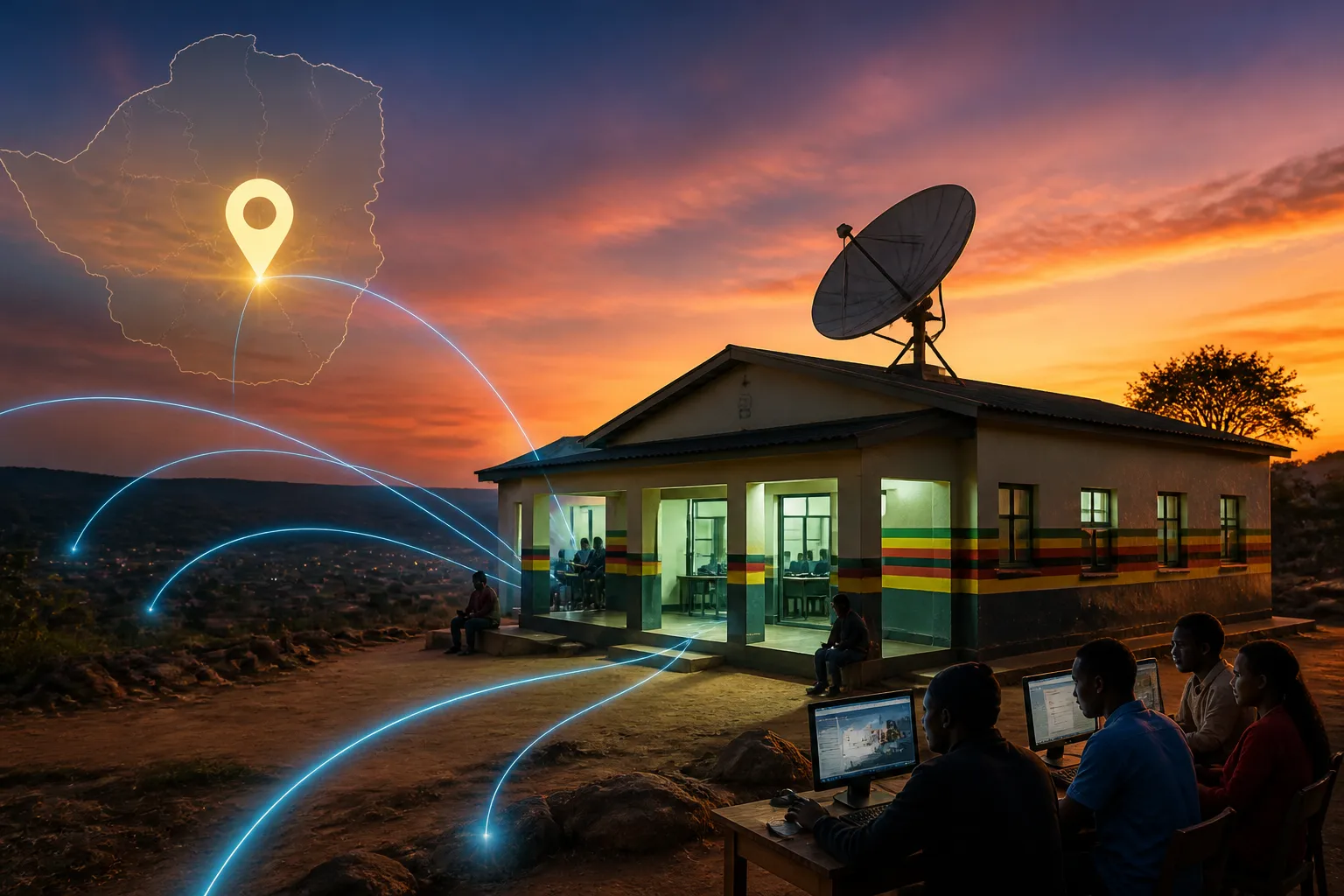
Zimbabwe’s latest digital inclusion milestone reached Masvingo on June 4, 2026, when the ICT minister officially commissioned the Nemanwa Digital Centre. The launch was linked to World Telecommunication and Information Society Day, giving the opening a broader policy context: the country is still trying to close the gap between urban internet access and the more limited connectivity available in rural areas.
The new centre matters because digital infrastructure is not only about browsing the web. In rural districts, a working centre can support online learning, public service access, small business activity, and basic digital skills. For residents in and around Nemanwa, the practical question is no longer whether digital inclusion is part of government policy, but how quickly the promised services will become usable on the ground.
Official figures released around the event suggest the rollout is advancing, but in more than one layer. The Herald reported that POTRAZ’s director-general said 98 digital centres had been upgraded nationwide. A separate parliamentary Hansard record states that 82 sites had been equipped with Starlink kits since August 2025, with more kits provided later for installation at post offices and connectivity to digital centres expected by June 30, 2026.
What the Nemanwa Launch Represents
The commissioning of the Nemanwa Digital Centre is best understood as part of a national connectivity programme rather than as a one-off local project. The event was staged in Masvingo on World Telecommunication and Information Society Day, which added a symbolic layer to the opening: the government is presenting digital access as a development issue, not merely a technical upgrade.
That framing matters in rural districts, where distance from major towns can make internet access uneven and expensive. When a digital centre is opened in a place like Nemanwa, it can potentially serve as a shared access point for people who do not have reliable home broadband, devices, or regular power at home. The usefulness of such a centre depends on whether it is actually operational, staffed, and connected in a way that users can rely on.
One detail that still needs careful separation is the relationship between the centre opening and the Starlink rollout. The sources support the existence of both initiatives, but they do not directly confirm that the Nemanwa centre itself was upgraded with Starlink. That distinction matters because the national numbers refer to different sets of sites and different stages of installation.
The Numbers Explained
The most important clarification from the available records is that 98 upgraded digital centres and 82 Starlink-equipped sites are not the same figure. The Herald report says POTRAZ’s director-general stated that 98 digital centres had been upgraded nationwide as part of the digital inclusion drive. Separately, the parliamentary record says the ministry had equipped 82 sites with Starlink kits since August 2025.
That difference is important for readers trying to understand the real pace of the rollout. An upgraded digital centre may involve improvements to facilities, equipment, or access arrangements, while Starlink equipment refers to a specific satellite internet connectivity solution. The available material does not show that every upgraded centre already has Starlink, nor does it show that every Starlink-equipped site is a digital centre in the same sense.
The parliamentary record adds another layer. It says 334 additional Starlink kits were provided in December 2025 for installation at post offices, with connectivity to digital centres expected by June 2026. That suggests the rollout was still being assembled in stages, with equipment moving through different public access points before the full network effect could be felt.
For households and small businesses, these distinctions affect expectations. A centre that has been physically upgraded but not yet fully connected may still fall short of what local users need. A site that has equipment delivered but not yet installed is not yet useful to the public. In other words, progress is visible, but not all progress is immediately usable.
A Short Timeline of the Rollout
The available record points to a rollout that has been building over several months. According to the parliamentary Hansard, the ministry had equipped 82 sites with Starlink kits since August 2025. The same record says an additional 334 kits were supplied in December 2025 for installation at post offices.
By June 2026, the planned target was to extend connectivity to digital centres. The Hansard record says that connectivity to digital centres was expected by June 30, 2026, which indicates a near-term deadline rather than a completed nationwide network at the time of the hearing.
The Nemanwa commissioning on June 4, 2026, fits into that sequence. It shows that the government was still rolling out visible infrastructure while the broader connectivity layer was being extended. The launch therefore reads less like the end of a programme and more like another step in a staggered national build-out.
For context, Zimbabwe’s digital inclusion push has to work through several bottlenecks at once: equipment delivery, installation, connectivity, power, and local capacity to keep services running. Each step can delay the next one. That is why opening ceremonies can be important politically, but the test for residents remains whether the facility functions day after day.
What Rural Communities Stand to Gain
If the centre in Nemanwa becomes fully usable, the most immediate benefit will be access. People in surrounding rural areas may be able to use the centre for online forms, communication tools, learning platforms, and other services that increasingly require internet access. For a district outside the main urban network, that can reduce the time and cost of travelling to town just to complete basic digital tasks.
Education is one of the clearest possible gains. Learners who do not have home connectivity can use public access points for research, exam preparation, and online coursework where available. Teachers and school administrators may also use the centre for administrative tasks that depend on digital platforms. The exact services available will depend on how the centre is managed, but the policy direction is aimed at widening opportunity.
Small businesses could also benefit. Rural entrepreneurs often need internet access for customer communication, product pricing, mobile commerce tools, and basic record keeping. A functioning digital centre can support that activity by lowering the barriers to participation in online markets and digital payment systems. The benefit is indirect, but it can still be meaningful.
Public service access is another likely use case. As more administrative processes move online, residents without personal internet access are the ones most exposed to delays. A local centre can help bridge that gap, provided it is dependable and affordable for regular use.
Fact Check: What Is Confirmed
- Date: The Nemanwa Digital Centre was officially commissioned in Masvingo on June 4, 2026.
- Occasion: The launch was tied to World Telecommunication and Information Society Day.
- Nationwide upgrades: POTRAZ’s director-general said 98 digital centres had been upgraded.
- Starlink rollout: A parliamentary record says 82 sites had been equipped with Starlink kits since August 2025.
- Additional equipment: The same record says 334 more Starlink kits were supplied in December 2025 for post offices.
- Pending point: Connectivity to digital centres was expected by June 30, 2026, according to the Hansard record.
- Still unclear: The sources do not directly confirm that Nemanwa itself was upgraded with Starlink.
What Still Needs to Happen Next
The next important checkpoint is the June 30, 2026 target mentioned in the parliamentary record. That date matters because it turns the rollout into a measurable promise. By then, the key question is not whether more equipment has been announced, but whether the equipment has been installed and whether digital centres are genuinely serving the public.
There are also practical questions that remain unresolved in the public record. Is the Nemanwa centre fully operational today? Does it have stable power backing? Are residents able to access it consistently, or is it still in the early stages of setup? Those details determine whether the launch is already changing daily life or simply marking the start of a longer process.
For now, the clearest reading is that Zimbabwe’s digital inclusion drive is moving forward, but in careful increments. The country has upgraded a substantial number of centres, distributed Starlink kits in phases, and set near-term connectivity goals. What comes next will be judged less by the ceremony and more by whether rural users in places like Nemanwa can actually log on, learn, work, and complete services without leaving their communities.