









Quantum computing has long promised new ways to tackle problems that strain even the best classical machines, from materials discovery to large-scale simulation. The obstacle is not only raw power. It is keeping quantum states stable long enough to do useful work.
A recent NTU Singapore feature, published on 11 May 2026 and originally appearing in Pushing Frontiers issue #26, brings together three strands of the university’s quantum research that aim at that core problem. The approaches are different, but the goal is shared: build qubits and quantum devices that are less fragile, more practical, and easier to scale beyond laboratory demonstrations.
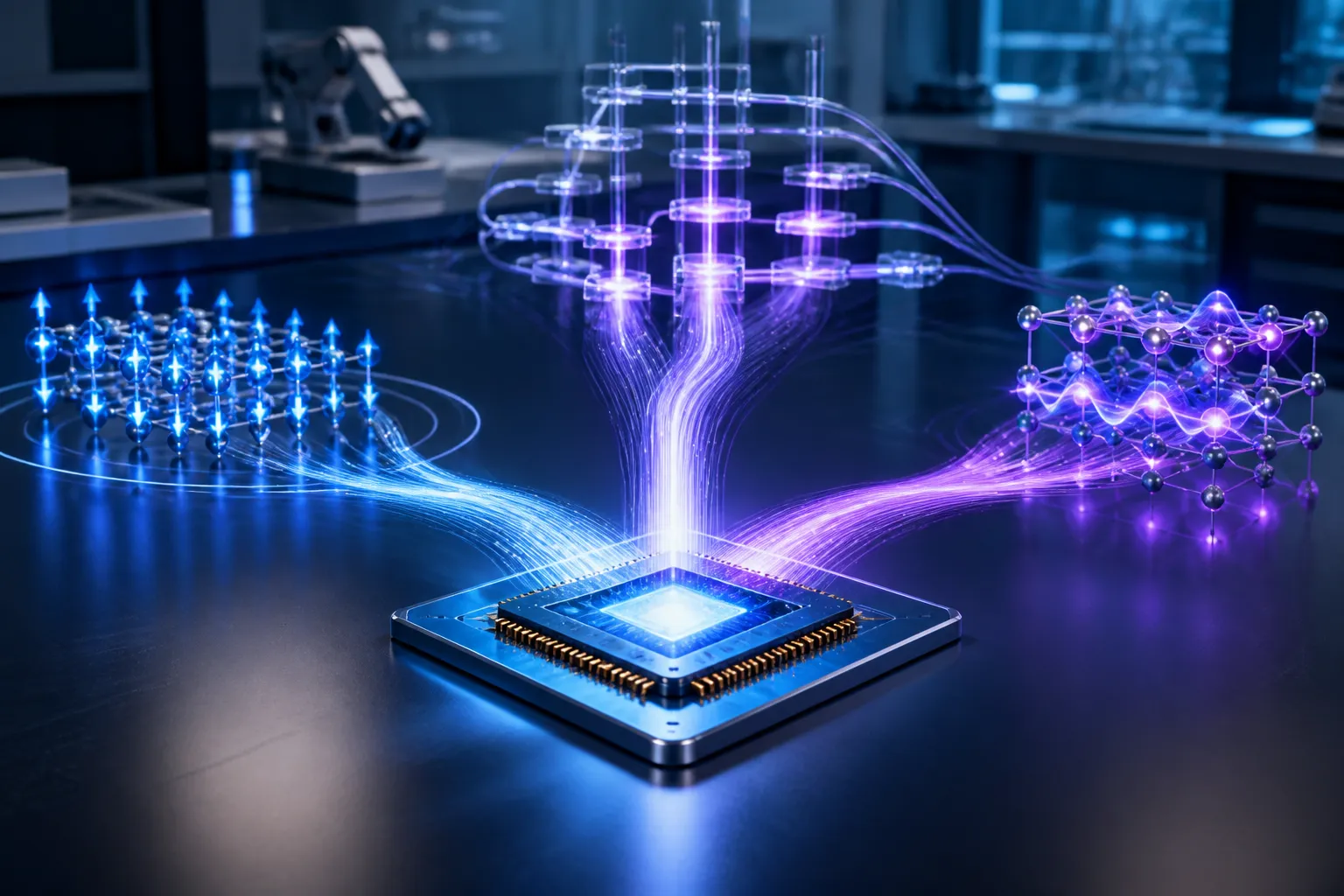
NTU’s work spans electron spin qubits, photonic circuits, and polariton-based systems. Each route addresses a different weakness in current quantum hardware. Together, they help explain where the field is headed and why the push for stability, integration, and even room-temperature operation matters for any future quantum industry.
What NTU Is Pursuing
NTU’s feature describes research into electron spin qubits, where scientists are working to extend qubit lifetimes in exotic materials. In quantum computing, a qubit must preserve its delicate state long enough to be manipulated and read out. Longer lifetimes are important because short-lived qubits force researchers to spend more effort correcting errors and less on doing actual computation.
The same feature also highlights photon-based approaches. These include integrated photonics platforms and light-guiding crystal structures designed to improve stability and reduce scattering. In plain terms, the research is trying to move quantum information through light rather than through more disturbance-prone systems, while keeping that light tightly controlled on a chip.
A third line of work focuses on polaritons, which are hybrid light-matter entities. NTU says these are being explored as a qubit platform that may operate at room temperature and tolerate external noise better than some alternatives. That matters because many quantum systems still depend on extreme cooling, which adds cost, complexity and engineering overhead.
Why Qubit Stability Matters
Most public discussion of quantum computing focuses on speed, but stability is the real bottleneck. Quantum states are sensitive to their environment, and that sensitivity is both the feature that gives the technology its power and the weakness that makes it hard to use. Small disturbances can destroy the information encoded in a qubit before a calculation is finished.
This is why researchers spend so much time on materials, device design and error reduction. A useful quantum computer is not just one that can host qubits; it is one that can keep them coherent, move information around them reliably, and scale without multiplying noise at every step.
Room-temperature compatibility raises the stakes further. If a system can operate without heavy cryogenic infrastructure, it could become easier to deploy, less expensive to run and more practical outside a handful of specialized facilities. That does not guarantee immediate commercial use, but it removes one of the biggest barriers between laboratory systems and real-world hardware.
How the Three Approaches Compare
NTU’s three routes are best understood as attempts to solve the same problem from different angles. Electron spin qubits are a more traditional hardware direction, using the spin of an electron as the information carrier. Their appeal lies in compatibility with solid-state devices and the possibility of dense integration, but the challenge is preserving coherence long enough to make calculations reliable.
Photonics takes a different path. Instead of relying on matter-based states that can be easily disrupted, photonic systems use light. The university’s feature points to integrated photonics and crystal structures that guide light more precisely, which helps reduce scattering and improve stability. That makes photonics attractive for communication between quantum components, and it fits a wider industry trend toward chip-based optical systems.
Polaritons sit between these worlds. Because they combine light and matter, they may inherit useful traits from both: the controllability of photonic systems and the interaction strength of matter-based systems. NTU’s framing is especially notable because it points to room-temperature potential, which could make polariton-based devices easier to operate than many current quantum setups.
Across the field, this kind of hybrid thinking is becoming more common. Researchers are not betting on a single “winning” qubit type. Instead, they are testing which physical platform can best balance coherence, manufacturability, scalability and operating conditions. NTU’s research fits squarely into that broader effort.
Timeline and Broader Context
The May 2026 feature does not appear in isolation. NTU says it first appeared in Pushing Frontiers, issue #26, before being republished on the university’s research pages. That makes it part of a continuing presentation of the university’s quantum work rather than a one-off announcement.
An earlier NTU research page, “Lighting the way to quantum computing,” helps fill in the backdrop. That page discusses photon emitters, slow-light photonic chips, room-temperature light-matter coupling, and a quantum photonic chip for molecular simulation. Taken together, the two NTU pages show a sequence of work that has been building around photonics and hybrid quantum systems rather than focusing only on one device type.
For Singapore, that matters because quantum research is part of a larger advanced-computing ecosystem. Universities, public research groups and industry partners in the country have been steadily developing capabilities in semiconductors, photonics and other enabling technologies. NTU’s work is one piece of that landscape, but it is a visible one because quantum computing depends so heavily on multidisciplinary engineering.
It also helps explain why the university is presenting the research as a set of practical routes rather than a single breakthrough. Quantum progress often arrives in increments: a longer-lived qubit here, a less noisy chip there, a better light-matter interface somewhere else. Each step can narrow the gap between theory and useful systems.
What It Could Mean Next
For researchers, the immediate significance is not that a fully practical quantum computer has arrived. The verified material does not support that conclusion. The value lies in the direction of travel: better qubit stability, more chip-friendly photonic systems and hybrid platforms that may work under less extreme conditions.
For developers and potential users of quantum hardware, those advances could eventually affect cost and deployment. Systems that need less cooling and fewer error-prone components are easier to imagine outside elite lab settings. That could matter for simulation, secure communications and other applications where quantum hardware may one day outperform classical methods.
For now, the unresolved question is which platform will prove most scalable in practice. Spin qubits, photonic circuits and polaritons each have strengths, but none has yet become the universal answer. NTU’s research suggests the field is still in the phase of sorting promising options from the physically difficult ones.
What happens next will likely come in the form of more specialized results: longer lifetimes for a spin qubit, more efficient light routing in a photonic chip, or better room-temperature light-matter coupling in a hybrid system. Those incremental advances are exactly what a practical quantum stack needs, even if they are less dramatic than a single headline-grabbing breakthrough.