

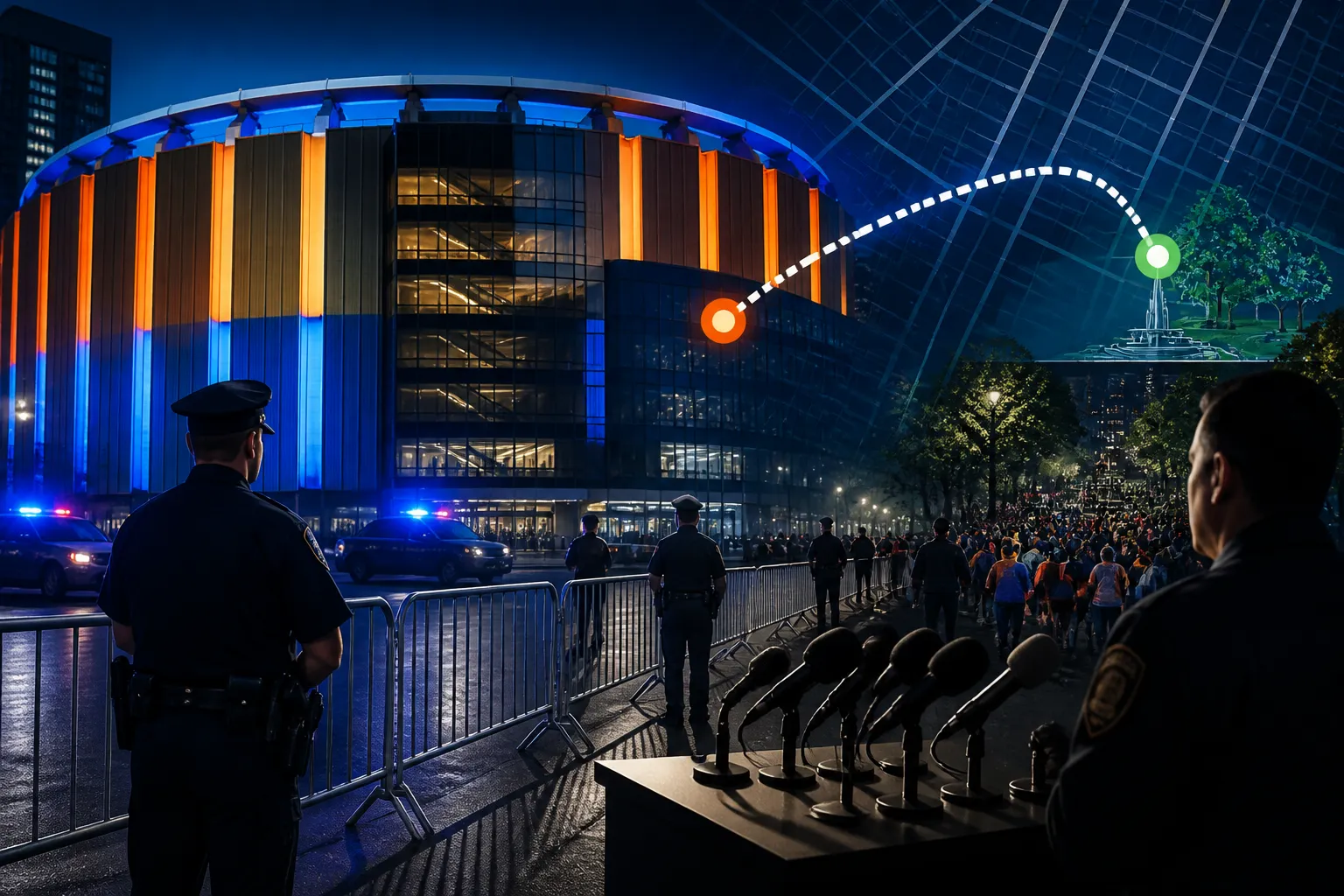
New York City’s celebration plans for the Knicks’ Finals run were reshaped by a security decision that pushed many fans away from Madison Square Garden and toward a more controlled setup at Bryant Park. What might have been a spontaneous street gathering in Midtown became a managed event after the Secret Service and NYPD said a watch party could not be held outside MSG because of heightened security requirements tied to President Trump’s attendance at Game 3.
The result was a familiar New York compromise: keep the energy, but reduce the risk. City officials moved to provide an alternative watch-party location while police restricted outdoor gathering near the arena, and NYC311 told residents there would be no outdoor watch party near MSG on June 8. Only ticketed or authorized individuals were allowed into the secure area.
The adjustment has also sparked a public dispute. Madison Square Garden Sports Corp. criticized Mayor Zohran Mamdani and NYPD leadership in response to the city’s security approach, while AP reported the company called them “New York City’s biggest party poopers.”
What Changed Around MSG
For Knicks fans, the main change was straightforward: the city did not allow an open outdoor watch party to form near Madison Square Garden. Instead, officials directed fans to another city-run gathering at Bryant Park, where the crowd could be handled in a more organized setting.
That decision mattered because Knicks postseason games have become large public events in their own right, especially in Midtown Manhattan, where the arena sits amid transit hubs, hotels and dense foot traffic. When a team is in the NBA Finals, the crowd outside the building can quickly become part of the story. The city’s response showed that in this case, celebration had to be balanced against a specific security plan already in place around the arena.
The Mayor’s Office said the extra Bryant Park watch party was announced after the Secret Service and NYPD determined that a watch party could not be held outside Madison Square Garden because of the heightened security requirements. That explanation is the clearest official account of why fans were redirected.
Timeline From Game 3 to Game 4
The sequence began with Game 3, when President Trump’s attendance prompted a stronger security posture around the arena. According to the verified reporting, the Secret Service and NYPD then concluded that a watch party outside MSG would not work under those conditions.
After that, the city announced an additional watch-party location at Bryant Park. Separately, NYC311 posted that there would be no outdoor watch party near MSG on June 8 and that only ticketed or authorized individuals could enter the secure area.
AP also reported that an earlier watch party ended with 21 people in custody and five officers injured. That detail helps explain why the city was reluctant to treat the next gathering as routine. The earlier disruption showed that large public celebrations around the Knicks can shift from festive to difficult for police to manage in a short time.
Taken together, the timeline suggests the city did not make a last-minute theatrical gesture. It reacted to a specific security environment, then moved fans to a different venue after the original setup was ruled out.
Why Security Was Tightened
According to the verified material, the main driver was not the basketball game itself but the security requirements attached to a presidential visit. When the President attends a major event, the Secret Service typically becomes part of the operational picture, and access around the venue can be narrowed to protect the secure perimeter.
In practical terms, that meant the area near Madison Square Garden could not operate like an ordinary outdoor fan zone. NYC311’s guidance made the access rules plain: there would be no outdoor watch party near MSG, and entry would be limited to people with the appropriate authorization.
That matters because the Knicks’ Finals run has been emotionally charged for fans and logistically complicated for the city. Street gatherings are part of the appeal, but they also require crowd control, transit planning and enough room for police and security teams to separate ticketed access from open public space. The AP report on the earlier watch party ending with arrests and injuries underscored the operational risk officials were trying to avoid.
The city’s position, based on the official and reported statements, was not that fans should stay home. It was that the celebration had to move to a place where the crowd could be managed more safely.
Who Was Affected by the Restrictions
The most visible impact fell on fans who expected to gather near MSG. Many of them were likely hoping for the kind of spontaneous, high-energy street celebration that often follows a playoff win or Finals appearance in New York. Instead, they were told that the secure zone would remain controlled and that any public watch party would be elsewhere.
That shift also changed the experience around Midtown. Restaurants, bars and transit riders near Penn Station and the arena often feel the effects of large game-night crowds, though the verified material here does not provide a local business impact estimate. What is clear is that the security perimeter limited the kind of open gathering that would normally spill into nearby streets.
Fans who wanted a public viewing environment still had a city-backed option at Bryant Park. The city’s decision to promote an alternate site suggests an effort to preserve the communal atmosphere without creating an unmanaged crowd outside the arena.
For the Knicks organization and MSG Sports, the issue was not only inconvenience. It touched on how the team’s playoff success is experienced in the city. A Finals run in New York can turn public space into part of the home-court environment, and restrictions on that space inevitably change the feel of the moment.
What the Public Dispute Means
The sharpest criticism came from Madison Square Garden Sports Corp., which took aim at Mamdani and NYPD Commissioner Jessica Tisch. AP reported that the company called them “New York City’s biggest party poopers.”
That line created headlines, but it should not obscure the underlying facts. The city said the restricted setup followed a security determination by the Secret Service and NYPD. The company’s criticism reflects frustration with the outcome, but it does not by itself change the reason officials gave for the restriction.
This is where the story becomes more than a simple fan gripe. The Knicks’ Finals appearance has drawn together sports, city government and national security planning. Those forces do not always line up neatly, especially in a city where a major arena sits in one of the busiest sections of Manhattan.
The dispute also shows how quickly postseason basketball can become a civic event with political overtones, even when the original issue is logistical. The verified material does not establish that the city’s decision was politically motivated, and that claim should not be drawn from the available reporting. What it does show is a public clash over how much celebration is possible when security requirements tighten around a game night.
What Happens Next
The next question is less about the team and more about crowd management. If the Knicks continue their run, New York will likely keep weighing the same tradeoff: public celebration versus a security setup that may change from game to game.
For now, the city has already established one answer. If the secure area around Madison Square Garden stays restricted, fans will be redirected to managed alternatives like Bryant Park rather than being allowed to gather freely outside the arena.
The open issue is how long that arrangement will last and whether it changes again if the security environment changes. The verified reporting points to a situation that is active, conditional and tied to the specifics of Game 3 and Game 4, not a permanent rule for every Knicks event.
That makes the situation a useful snapshot of the Finals in New York: a huge basketball moment, a tightly controlled security perimeter and a city trying to keep the celebration going without losing control of the crowd.