








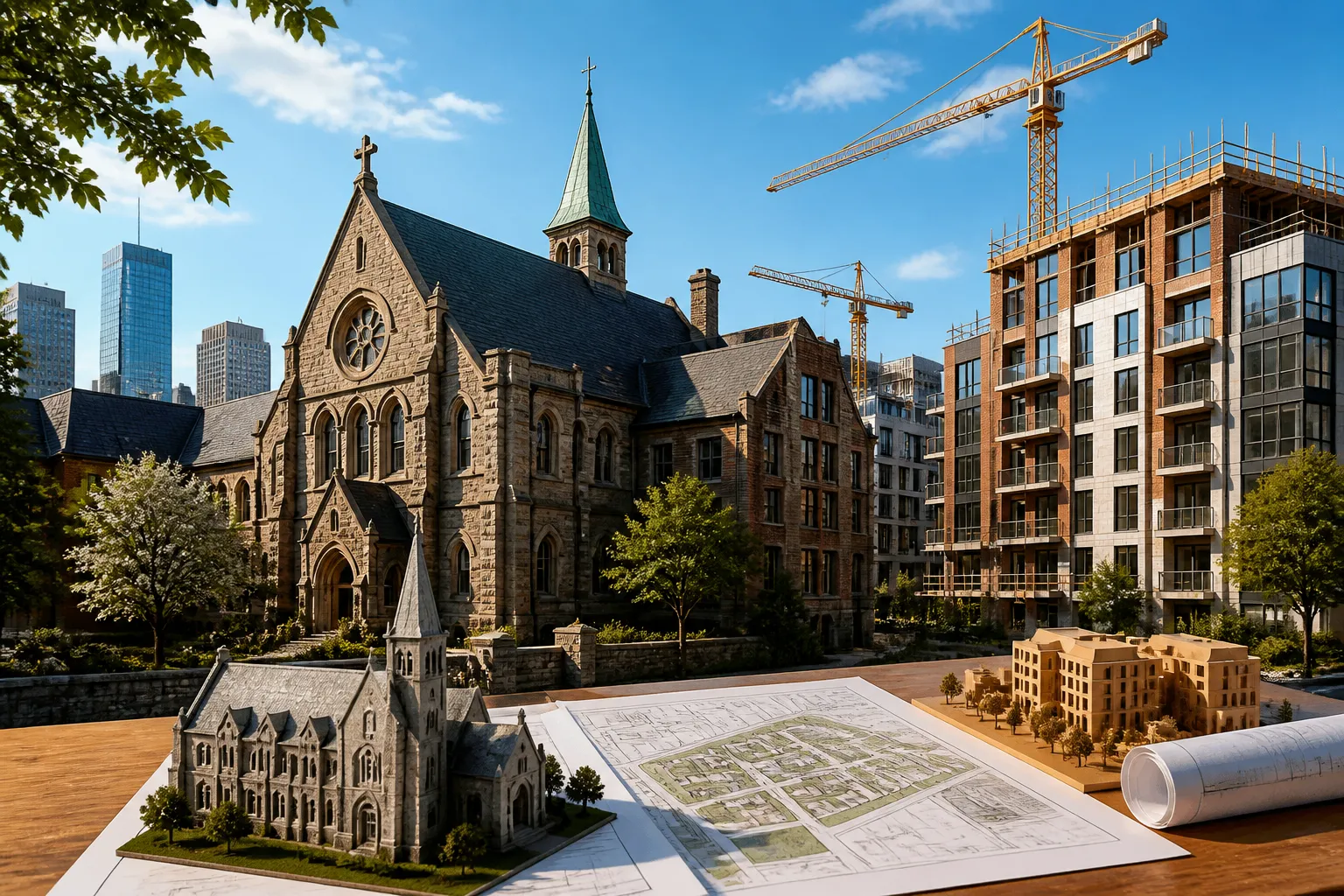
Boston’s latest monastery redevelopment proposal is not the demolition story that some headlines might suggest. The official plan for 159-201 Washington Street in Brighton calls for restoring St. Gabriel’s Monastery and the adjacent church, keeping the Shrine of Our Lady of Fatima, and renovating the vacant house at 201 Washington Street.
In business and development terms, the project is a large mixed-residential proposal. Boston’s planning documents describe roughly 555 apartment units and 105 condominium units, for about 660 homes in total. That makes the site one of the larger housing proposals tied to a historic religious property in the city.
The distinction matters because the project has circulated alongside other Boston monastery redevelopment stories, including a separate proposal in Jamaica Plain involving the former Poor Clare Nuns monastery. That one centers on a different site and a different unit count. For the Brighton project, the current planning materials point to preservation and adaptive reuse, not full demolition of the monastery.
What the Brighton plan calls for
According to Boston’s official project page and development plan, the St. Gabriel’s proposal combines new construction with the reuse of historic structures. The plan includes four new residential buildings, together with the restoration of the monastery and church and renovation work on the vacant house at the edge of the site.
The mix of units is also important. The planning documents break the housing program into apartments and condominiums, suggesting the site is being positioned as a substantial residential community rather than a single-format building. That kind of mixed housing can widen the project’s reach, though the official materials provided here do not spell out affordability details.
What Boston’s planning materials do make clear is that the monastery and church are intended to be substantially rehabilitated. That is a significant difference from a redevelopment proposal that would clear the site outright.
How the proposal shifted from demolition to reuse
The Boston Preservation Alliance says the St. Gabriel’s project originally contemplated demolition of the church. In its current form, however, the proposal preserves the most historically significant resources and has preservation support.
That shift reflects a familiar Boston planning tension. Large housing proposals often face strong pressure to produce units quickly, especially on underused land, but historic sites bring another layer of review. Churches, monasteries, and related religious buildings can be difficult to adapt because they were not designed for apartment living. At the same time, their size, architecture, and neighborhood presence make them attractive candidates for reuse when preservation is feasible.
In this case, the official plan suggests the developer and city reviewers have moved toward a hybrid answer: build new housing where appropriate, but keep the core historic complex in place. For preservation advocates, that kind of outcome can be preferable to either abandonment or demolition. For housing advocates, the question is whether that compromise still delivers enough homes to matter in a tight market.
Why it matters for housing and preservation
The Brighton project sits at the intersection of two of Boston’s most persistent policy goals. The city needs more housing, yet it also has a long record of architectural preservation and neighborhood review. Large infill projects on institutional or religious sites often become test cases for how those goals can coexist.
On the housing side, roughly 660 units is a meaningful addition. A project of that scale can change the character of a block, add residents to nearby transit and commercial corridors, and create pressure for better traffic management, parking planning, and open-space design. Even without a final affordability breakdown in the verified material, the total number of homes alone suggests a substantial increase in neighborhood density.
On the preservation side, the monastery and church are the heart of the site’s public value. Boston Preservation Alliance’s support for the current plan indicates that the proposal now aligns more closely with the group’s preservation priorities than the earlier demolition concept did. That does not eliminate debate, but it does signal that the revised approach has crossed an important threshold for some preservation stakeholders.
The project also highlights a practical reality of redevelopment in historic neighborhoods: preservation is often not a separate issue from housing production. It can shape building placement, construction phasing, landscaping, circulation, and the amount of open space left in the final design.
Who is affected by the redevelopment
For nearby residents in Brighton, the most immediate issues are likely to be construction activity, traffic, and how the new buildings fit into the existing street pattern. A site with four new residential buildings and a restored historic core is likely to change how people move through the block, even if the monastery and church remain standing.
Longer term, the development could affect local housing supply and the neighborhood’s mix of residents. Apartments and condominiums serve different buyers and renters, and a combination of the two can create a broader market than a single building type. The verified materials do not provide a final affordability or ownership breakdown beyond the apartment and condo counts, so any deeper conclusion would be premature.
Historic-preservation advocates are also affected because the project represents a notable example of reuse rather than loss. Religious and institutional properties can sit vacant for long periods if no redevelopment path emerges. A plan that keeps the most recognizable historic elements intact can preserve neighborhood identity while still allowing the site to function economically.
The comparison to the Jamaica Plain monastery proposal is useful here. That separate project, tied to the former Poor Clare Nuns monastery, has been reported as a proposed 123-unit redevelopment and remains in city review. It shows that Boston is seeing multiple monastery-to-housing conversions at once, but each site is moving through its own process, with different scale, design, and preservation questions.
What happens next in Boston’s review process
Boston’s development review process does not end with the filing of a proposal. Projects of this size typically move through planning review, public discussion, and any necessary preservation or landmark-related steps before approvals are finalized. The verified materials provided here do not indicate that St. Gabriel’s has reached a final decision.
That means the key unresolved issue is not whether the site is being discussed for housing. It is how the final project will balance building mass, historic rehabilitation, and neighborhood impacts before the city signs off.
For readers following the case, the practical milestones to watch are straightforward: whether the preservation approach holds, whether the overall unit count changes, and whether any conditions are attached to the final approval. Those decisions will show whether Boston treats the project primarily as a housing supply opportunity, a preservation win, or a negotiated mix of both.
For now, the official record is clear on the basic facts. St. Gabriel’s in Brighton is being proposed as a large adaptive-reuse redevelopment with four new residential buildings, preserved historic structures, and about 660 total homes. That is a materially different story from a simple demolition claim, and it is the version that better reflects the city’s planning documents.